We would like to congratulate Dylan Meanchos of the North Toronto Minor Peewee AA Team.
Dylan’s strong goaltending was instrumental in leading North Toronto to the GTHL City Championship. Here is a picture of Dylan hoisting the trophy after the final game.
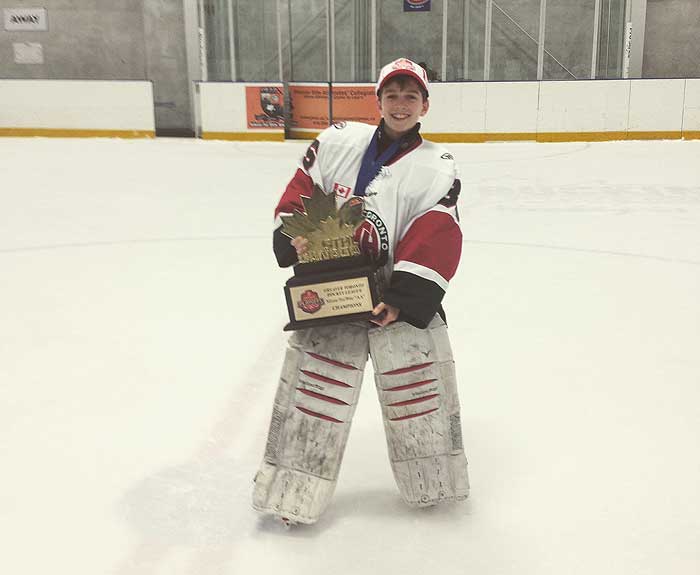
Category: Uncategorized
-
Dylan Meanchos
-
The Aggressive Poke Check
The Aggressive Poke Check and the Empty Cup
Many years ago, when I was a little boy growing up in Windsor, Ontario… I couldn’t wait until Saturday night when the family would gather in front of an old black and white television to watch Hockey Night in Canada. In those days, the game always came on at 9 o’clock or at about the halfway point in the second period. As a boy, I was always captivated by the courage of those maskless goaltenders with their tortured facial expressions. In those days, there were only six goalies and as their admirers, we came to know them intimately. Each goalie was known for his own special style and mannerisms which we would emulate in every game of ball hockey we played throughout the week. Glenn Hall was known for his acrobatic, butterfly style, Jacques Plante for his grace and elegance, Gump Worsley for his chin first courage and the great Johnny Bower was known for his poke check.
To their detriment, many of today’s “modern goalies” don’t have even foggiest understanding of how to execute this important move. While coaching at York University, I tried teaching it to one of our goalies who had already played four years of Major Jr. “A”. I tried explaining how important the move was and how it would make him a better goalie if he would only add it to his “bag of tricks”. He responded that today’s players were too fast and that it simply didn’t have a place in the “modern game”. I respectfully disagreed but not before advising him of the old Zen teaching that a cup that is already full can have nothing added to it. His full cup and his misconceptions meant that nothing could be added to his game. As fate would have it, the following week, the goalie from Laurier made a game saving poke check and they went on to defeat us by a single goal.
Let me begin by saying that I understand the real reason for my young goaltender’s reluctance to even learn the move. It is a move that requires great trust and forces the goaltender to step outside the “robotic” structure that many have been taught from their earliest years. Structure is a good thing in goaltending but it should not become a straight jacket that prevents a goalie from learning new techniques. The poke check also has a structure and once this structure is perfected, the poke check is one of the most important tools a goalie can add to his repertoire.As an old goalie coach with over 40 years of coaching experience, I still can’t wait for Saturday night so I can watch Hockey Night in Canada and marvel at the skills of today’s goalies. They fill much more net than my childhood heroes did and they have perfected some skills never dreamed of all those years ago. Yet, as great as today’s goalies are, very few know how to use the poke check and they give up dozens of goals as a result.
About 12 years ago, two young goalies from Sweden attended a one week “Elite Camp” that I was conducting for my good friend Wes Jarvis at NTR in Newmarket. I was told that one of them was the best goalie for his age in all of Sweden. Both goalies were very good… Joachim spoke some English but Jonas didn’t understand a single word… so Joachim would have to translate everything for his friend. Since this was an “Elite” camp, I thought it proper to introduce the aggressive poke check to our young friends. Unlike my goaltender at York University, the young Swedes were thirsty for new knowledge and their cups were empty enough to receive. Both youngsters were awkward in their early attempts at this “new” move but they had enough trust and humility to endure their initial struggles. Within the hour, they mastered the structure of the manoeuvre and with added practice they eventually gained the confidence to use it in game situations.The next time Jonas came to Canada it would be to sign a contract to play for the Toronto Maple Leafs. One Saturday night a few years ago, as I watched Hockey Night in Canada on my High Definition 52 inch flat screen colour television, a left hand shooter raced down the wing and broke in on the Leaf’s goal on the blocker side. Jonas stood high on his crease without retreating and with a slight lean to the puck, he forced the shooter to shift to the open ice in front of the net. As the attacking player made the only move open to him, Jonas slid his hand up the shaft of his stick all the way to the knob, dropped into a short-side pad stack and extended his stick to centre ice. This all happened in a flash… the attacking player didn’t know what hit him as he was stripped of the puck and sent sliding into the opposite corner.
I have not spoken with Jonas since he attended my goalie camp all those years ago… but if I could, I would tell him to ignore the critics, keep working hard… and always be an empty cup … He has made this old coach proud… not of himself… but of him.
Jonas now plays for the Detroit Red Wings and if you click the link below you can see him make the move that the great Johnny Bower thrilled us with in black and white all those years ago.
-
Glove Position Debate
In recent years, there has been a growing tendency for goalies at all levels to hold their glove hand high and in “a fingers up” position as opposed to the more traditional waist high 3 o’clock position. The rationale for holding the glove in the former position is that it takes the top shelf away and most easily intersects with the trajectory of the puck. This is all very nice in theory but in practice it simply doesn’t work very well. Even those goalies who start with their gloves in this position (Henrik Lundqvist) rotate downwards to the 3 o’clock position before making most glove saves.
So, why do I make the assertion that the fingers up / glove high position doesn’t work very well? I think the best way to explain myself is to look at the basic rationale for holding the glove in this way. First, does the high position actually take away the top of the net? The answer to this is simply NO. To understand exactly what the glove is covering it is necessary to put your face on the ice directly behind the puck and assume the vantage point of the puck at ice level. After doing this you will discover that the high glove position isn’t covering ANY net at all… in fact, it is covering glass. To make matters worse, the goalies are covering glass while giving up EVERYTHING from the crossbar down. Goalies that hold their gloves at the more traditional 3 o’clock position are ACTUALLY covering the top shelf while making it easier to catch pucks 18 inches off the ice.
The second issue is intersecting with the trajectory of the puck. The high glove, held in a fingers up position, requires the goalie to move the glove against the trajectory of the puck. This turns the glove into a blocker as opposed to a catcher. Another complicating issue is that the glove often rotates down in a counter clockwise motion which results in dropped pucks. The lower more traditional position allows the goalie to move up with the trajectory which is actually a quicker move because it requires muscular contraction and allows for more glove control.
I don’t really think that I will have changed many minds here. Those who believe in the high glove will come up with all kinds of fallacies to support their position. I once heard a goalie coach say that coming down on the puck was quicker because of gravity. REALLY? Watch any great glove save in the NHL and there is ALWAYS an upward arch to the save which means the glove had to start in a low position. I have seen precious few glove saves made from the high position unless the puck simply hit the glove… which means that the puck was probably going over the net in the first place and the goaltender’s glove was “locked” in a blocking position instead of moving with the puck.
As in all cases, the best teacher is experience. If you find that your glove hand is a static blocker instead of a dynamic and active catcher of pucks, you might take a look at where your glove actually starts the catching motion. Take a few moments a go on NHL.com and watch the NHL goalies making glove saves, hit the freeze button at the point when the puck is released and you will see that the glove hand actually starts its motion from a low rather than high position.