Category: Goaltending

  • Kevin Marx and Joseph Lagambina

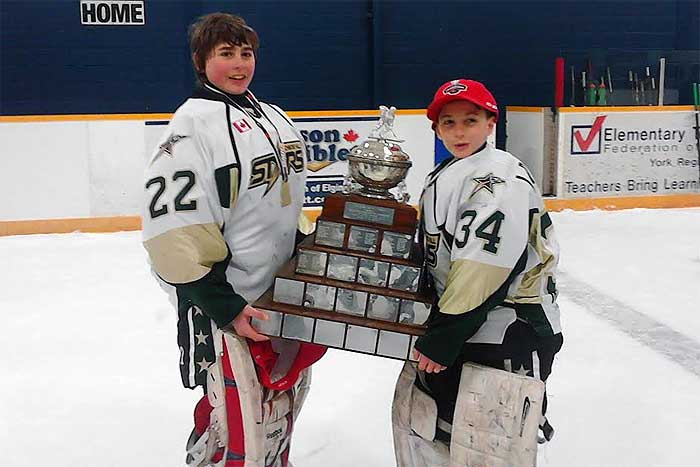
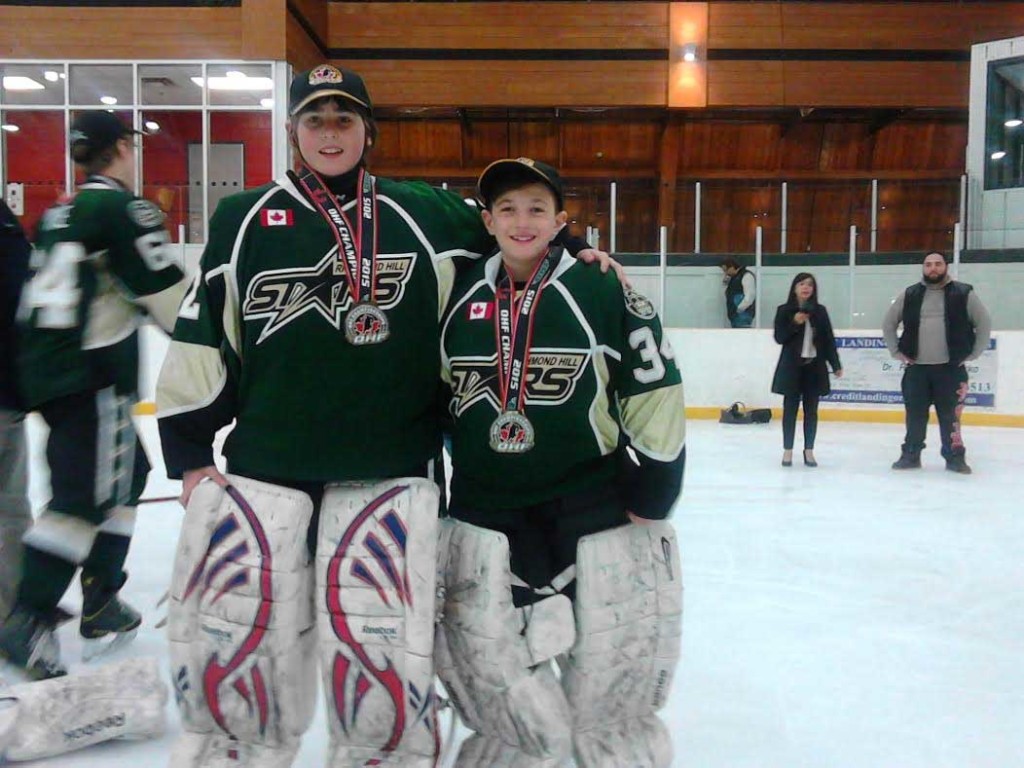
    We would like to congratulate two very special young goalies. Kevin Marx and Joseph Lagambina were instrumental in leading the Richmond Hill Stars Peewee AA team to the O.M.H.A. Championship. They followed this by winning the O.H.F. Championship as the best Peewee AA team in the province. Kevin and Joseph are pictured hold the O.M.H.A. Championship trophy and proudly wearing their O.H.F. Gold Medals.

    stars

    rhstars

  • Congrats to Matthew Galajda

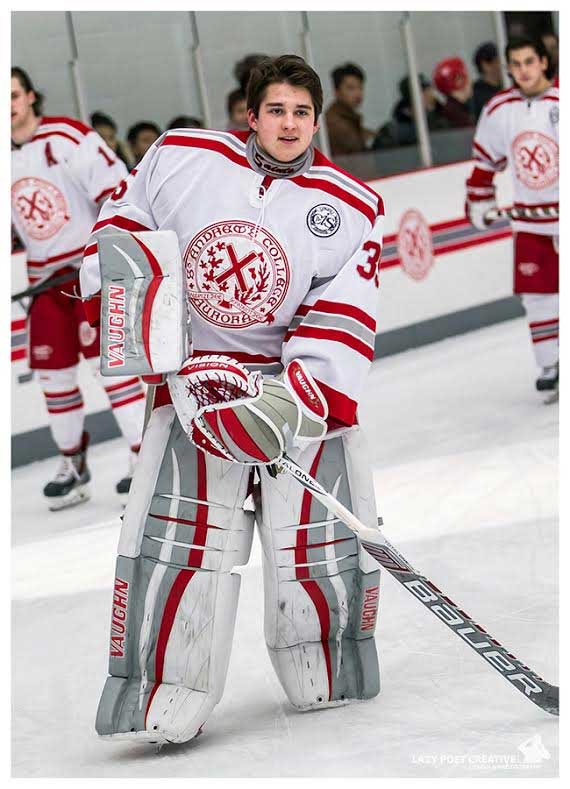
    We would like to congratulate long time student and current instructor Matthew Galajda for his outstanding career as the goaltender for the Saint Andrew’s College Varsity Hockey Team. In his two years with the Saints, Matthew finished with a record of 56 wins, 6 losses and 4 ties. His save percentage was a remarkable 0.941 and his G.A.A. was 1.3 over 67 games. Matthew was instrumental in leading the Saints to two CISAA Championships, a National Independent School Championship, the World Sport School Championship and two St. Sebastian Tournament Championships. As a final accolade, Matthew was named the M.V.P. of the National Tournament and M.V.P. of the Varsity Hockey Team. Next year, Matthew will be playing Jr. “A” hockey in the BCHL.

    mattg

  • O.H.L Goaltending Advisory Board Announced

    O.H.L Goaltending Advisory Board Announced

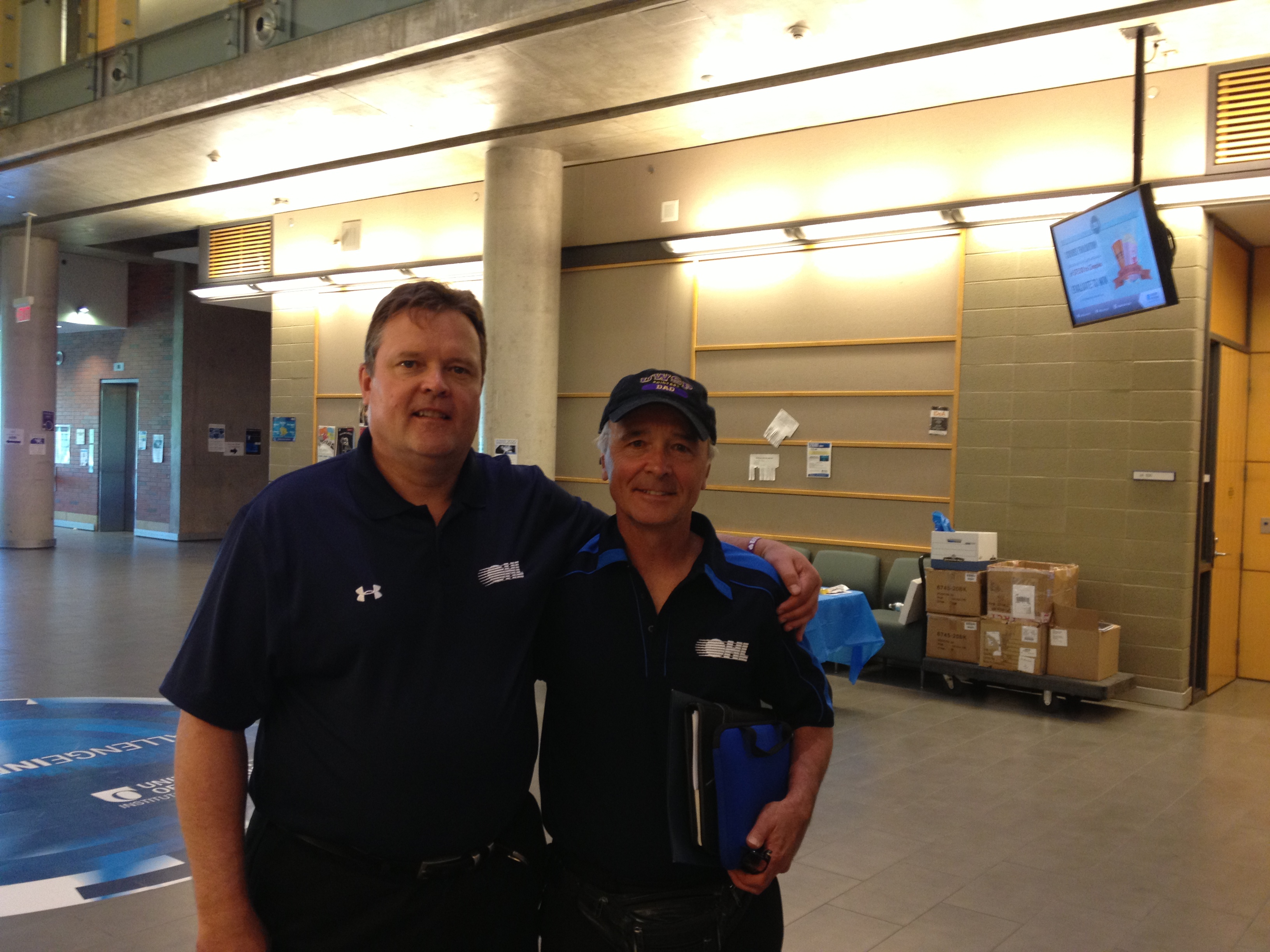
    We are pleased to announce that Steve Davies has been selected to be a member of the O.H.L.

    Goaltending Advisory Board. The mission of the Board is to work to improve goalie training

    at all levels of hockey throughout the province. The Advisory Board is led by former N.H.L.

    goaltender and Master Coach, Rick Wamsley of the Ottawa Senators. Other members of the

    Board include: Fred Brathwaite (Hockey Canada), Sebastien Farrese (Belleville Bulls), Kory

    Cooper (Mississauga Steelheads), David Rook, (Sarnia Sting) and David Belitsky (O.H.L. Central

    Scouting)

    Steve is honoured to join a group of such knowledgeable and dedicated goalie coaches. He

    hopes to make a meaningful contribution to the success of the group.

  • Glove Position Debate

    In recent years, there has been a growing tendency for goalies at all levels to hold their glove hand high and in “a fingers up” position as opposed to the more traditional waist high 3 o’clock position. The rationale for holding the glove in the former position is that it takes the top shelf away and most easily intersects with the trajectory of the puck. This is all very nice in theory but in practice it simply doesn’t work very well. Even those goalies who start with their gloves in this position (Henrik Lundqvist) rotate downwards to the 3 o’clock position before making most glove saves.

    So, why do I make the assertion that the fingers up / glove high position doesn’t work very well? I think the best way to explain myself is to look at the basic rationale for holding the glove in this way. First, does the high position actually take away the top of the net? The answer to this is simply NO. To understand exactly what the glove is covering it is necessary to put your face on the ice directly behind the puck and assume the vantage point of the puck at ice level. After doing this you will discover that the high glove position isn’t covering ANY net at all… in fact, it is covering glass. To make matters worse, the goalies are covering glass while giving up EVERYTHING from the crossbar down. Goalies that hold their gloves at the more traditional 3 o’clock position are ACTUALLY covering the top shelf while making it easier to catch pucks 18 inches off the ice.

    The second issue is intersecting with the trajectory of the puck. The high glove, held in a fingers up position, requires the goalie to move the glove against the trajectory of the puck. This turns the glove into a blocker as opposed to a catcher. Another complicating issue is that the glove often rotates down in a counter clockwise motion which results in dropped pucks. The lower more traditional position allows the goalie to move up with the trajectory which is actually a quicker move because it requires muscular contraction and allows for more glove control.

    I don’t really think that I will have changed many minds here. Those who believe in the high glove will come up with all kinds of fallacies to support their position. I once heard a goalie coach say that coming down on the puck was quicker because of gravity. REALLY? Watch any great glove save in the NHL and there is ALWAYS an upward arch to the save which means the glove had to start in a low position. I have seen precious few glove saves made from the high position unless the puck simply hit the glove… which means that the puck was probably going over the net in the first place and the goaltender’s glove was “locked” in a blocking position instead of moving with the puck.

    As in all cases, the best teacher is experience. If you find that your glove hand is a static blocker instead of a dynamic and active catcher of pucks, you might take a look at where your glove actually starts the catching motion. Take a few moments a go on NHL.com and watch the NHL goalies making glove saves, hit the freeze button at the point when the puck is released and you will see that the glove hand actually starts its motion from a low rather than high position.

  • Gone Fishing and the Overlap of Generations

    Several years ago I was on a pontoon boat on Lake St. Claire with my brother, John and a bunch of friends to open the bass fishing season. This annual event has marked the beginning of summer for John and me for about the past fifteen years. I’m not much of a fisherman so my role is that of official “hook baiter” and “fish remover”.

    For me, it’s not about fishing; it’s really about spending time with my pals and listening to all their funny stories and just hanging out. John is simply one of the best and most generous people I have ever known. He and his wife live in Windsor and are avid hockey fans. They have season tickets the Red Wings and they also billet kids who play for the Windsor Spitfires of the Ontario Hockey League. Occasionally, some of the aspiring young hockey stars join us… and I have as much fun listening to their tall tales as I do those of all the other “liars” on the boat. We have lots of laughs during the day and the evening is usually spent by a bonfire talking hockey.

    On one excursion when the young hockey players joined us, our bonfire conversation turned to comparing the hockey played in ancient times to the hockey played today. I was amused that the budding hockey stars had very little understanding or appreciation for just how good the players were in the days of black and white television. I tried to explain to them just how great players like Bobby Hull, Gordie Howe and Jean Beliveau really were… sadly, some had never even heard of the great Jean Beliveau.

    They listened patiently until I asserted that each of the aforementioned players, and many others of that era would be stars in today’s NHL. They countered with the all too familiar claim that today’s players are bigger, stronger and faster than those who graced the rinks decades ago and that today’s players are far superior. I conceded to one or possibly two of their assertions. Yes, it can be statistically proven that today’s players are, on average, bigger than those who played in the Bobby Hull, era… and I think they are correct in asserting that on average, today’s players are probably stronger. After all, they spend more time in the weight room than those of earlier vintage. However, I challenged the assumption that Jonathan Toews and Sidney Crosby are faster or better players than the stars of earlier generations..

    Obviously, these “youngins” never saw Yvan Cournoyer, Maurice Richard, Bobby Hull or Guy Lafleur in full stride or in “High Definition”. However, this doesn’t mean that today’s NHL isn’t played at a more frantic pace. Today, teams usually run four lines and with shifts rarely exceeding forty-five seconds, it stands to reason that the tempo is a little quicker. On top of this, the two line pass has allowed for more speed in the neutral zone and because the “D” are no longer allowed to obstruct or “hold up” the fore-check, the attacking forwards go into the corners at full speed. Is there any wonder that despite having the most protective equipment possible there are more serious concussions than ever before? No… I don’t buy for a moment the argument that today’s players are one inch faster than those of yesteryear. Yes, the game itself is faster and played at a more frantic and even dangerous pace… but stride for stride I see little difference in player speed or skill.

    So… having conceded that today’s players are, on average, bigger, stronger and at least as fast as in previous generations, does it not logically follow that they are better? That’s certainly an interesting argument and one that was quickly put forward by the young lads. I replied that two plus two doesn’t always make four. They looked at me as though I had two heads. I said… let me put it this way… Wayne Gretzky was never considered to be one of the fastest skaters in the league, nor was he anywhere near being one of the strongest. Yet, Gretzky is widely regarded as one of the greatest, if not THE GREATEST player of all time. (Personally, I’m even more convinced of this after seeing how the Bruins completely shut down Crosby in their recent playoff series. There isn’t a team in the world that could have done that to The Great One). Gretzky did things that can’t be measured with a stop watch or a bench press. He simply had the ability to seemingly disappear from view and then suddenly reappear with the puck glued to his stick. He would then make a pass from nowhere to somewhere and the puck would end up in the net. No matter what the opposition did, he was magical and dangerous for every second of every shift he ever played. You see, the greatness of the Great One had nothing to do with size, strength or speed.

    My young friends wouldn’t buy a single word of my argument. They even went so far as to say that Gretzky played against inferior competition and that he would be little more than an average player in “today’s NHL” . This was one of the most incredulous statements I could possibly have imagined anyone making and it demonstrated just how limited their understanding of the game really is. I counseled that each generation of hockey players overlaps with the previous generation. For example, the Rocket Richard era overlapped with the Bobby Hull era, which in turn overlapped with the era of the incomparable Bobby Orr… and then came the Guy Lafleur era which overlapped the Gretzky generation to be followed by Lemieux and so on… and so on… until we come to the players of today. Each of the aforementioned players stood in awe of those already playing in the League when they arrived on the scene.

    A great player like Guy Lafleur took several years to find his legs in the NHL of the early 1970s and he was still playing in the NHL in 1991 with the Quebec Nordiques, alongside newcomers Matts Sundin and Joe Sakic. Even my young friends had to admit that both Sundin and Sakic would be star players in today’s league while curiously they were reluctant to grant Lafleur that same status. Having seen all three of these players in their prime, there isn’t a doubt in my mind that Lafleur was easily as good as the other two. And if we were to throw Gretzky into the mix, there shouldn’t be a doubt in anyone’s mind as to which player was the best of the four.

    Still, my young friends needed more persuading. So, I went on to tell them that the greatest team I ever saw in my over 55 years of watching hockey was the Canada Cup Team of 1987; precisely that era of hockey they claimed to be vastly inferior to the NHL of today. In that year, Team Canada boasted players like, Mario Lemieux, Wayne Gretzky, Doug Gilmour, Mark Messier, Mike Gartner, Dale Hawerchuk, Paul Coffey and the recently retired Raymond Bourque. It is also worth noting some of the great players who were actually cut from this dream team. These include Hall of Famers Steve Yzerman, Al MacInnis, Dino Ciccarelli, Scott Stevens, Patrick Roy, and Cam Neely. At this point, I began to win some of my younger friends over.

    All of them had to admit that Yzerman, Stevens and Roy would be stars today…. but why is that? I think it’s because they saw these superb players when they were in their prime. They grew up watching them on colour televisions and on telecasts with a multitude of camera angles that accurately conveyed and perhaps even accentuated the speed of the game. The old technology that ancients like me grew up watching, captured the magic of hockey… but to appreciate the speed of the game one actually had to make a pilgrimage to one of the hockey cathedrals like the Detroit Olympia, the Montreal Forum or Maple Leaf Gardens.

    As for today’s players, I marvel at their skills, their speed and the frantic pace at which they play this wonderful game that has become such an important part of the Canadian consciousness. Yet, I can only wonder what these great players of today would look like on the old black and white television that I watched Gordie Howe , Bobby Hull and Bobby Orr play on? I think they would look like the great players they truly are … but they would not be one inch better than the hockey heroes of yesteryear.
  • Some Thoughts on Pulling the Starting Goalie

    One of the most difficult situations you will encounter as a goalie occurs when the coach makes the decision to pull you from the game. When this happens, the goaltender is often filled with a sense of failure in having not lived up to his own personal expectations or those of the coach and team.

    These are natural feelings and you might take some consolation in the knowledge that even the best goalies in the world have been pulled more than once. In fact, the higher you climb on the ladder of competitive hockey, the more demanding coaches become of their goaltenders. The fact that many coaches don’t understand the position very well doesn’t make things any easier.

    After getting pulled, it is important to keep your emotions under control. Slamming the door or sulking on the bench won’t make things any better. On the way off the ice, give the incoming goalie a tap on the pads and when you get to the bench take some deep breaths.

    In a few minutes, the anger will subside and you can then do the self-analysis that is required to make the most of the situation. The self-analysis should be the same as you would do after every game. Replay the goals you gave up and rate them as:

    A) I simply should have had it.
    B) I could have had it but it would have been a good save.
    C) I didn’t have a chance.
    D) Was there anything I could have done differently on any of the goals?

    It is also important for you to understand that sometimes goalies are pulled for other reasons than poor play. Frequently coaches make this move because they have run out of options in their efforts to turn the game around. Unfortunately, the goalie becomes the scapegoat for the team’s indifferent play. I know this doesn’t always seem fair but life in hockey isn’t always fair and this in itself is an important lesson.

    From the coaching standpoint, I think it is critical for the coach to give immediate reassurance to his goaltender by going down to the end of the bench and having a quick word with him. It could be something as simple as “keep your chin up… it’s just an off night… every goalie has them.” or “the team wasn’t playing for you… it’s not your fault.” I can tell you from personal experience, it will ease the goaltender’s sense of dejection and it will also keep the lines of communication open.

    In terms of communication, it is surprising how many goaltenders get pulled from games without any understanding of why they were pulled. Their goal analysis didn’t reveal any goals that they should have had. To make matters worse, the coach didn’t offer any explanation to the goalie at the end of the game. Personally, I don’t think it’s the responsibility of the goaltender to approach the coach for answers. The coach should be the one to speak with the goalie after the game to offer his reasons for making the move and also offer his reassurance and bolster the goalie’s confidence.

    Personally, I have very mixed feelings on whether or not coaches should pull their starting goalie during the regular season. I have spent almost fifty years in hockey as a goalie, goalie coach, goalie parent, high school coach and AAA coach with the York Simcoe Express … so I think it’s fair to say that I have had to look at this issue from almost every angle. I should begin by saying that I fully understand the myriad of reasons that coaches frequently use for pulling their starting goaltender. Each can be justified as being good for the team and also, in the long run, for the goalie involved. However, after over 30 years behind the bench as a Head Coach, I have only pulled my starting goalie once.

    So why have I only removed my starting goaltender once in all those years behind the bench?

    1. I think it’s important for the goalie to know that it’s his game no matter what. I don’t want my goalie looking over his shoulder for the hook after giving up a couple of bad goals. I have, on occasion, pulled the starting goalie for a couple of shifts to help him refocus. Naturally, there are pros and cons to this move.

    2. It is important for me to know if my goalie can battle back from a bad start and finally find his game. This is an important piece of knowledge as the team moves into the playoffs.

    3. The season should be used for giving every player the chance to develop. I don’t think pulling a goalie helps in the development of the goaltender. Playing time is essential and to deprive the goalie of playing time is counter- productive to the goalie and ultimately to the team.

    4. It all depends on the importance one attaches to winning. As one moves into the playoffs where winning is of more importance, I would be more inclined to pull the goalie for the aforementioned traditional reasons. However, winning during the season is not nearly so important. I prefer to see these games as preparation for the playoffs. Therefore, my goalies should get as much playing time as possible.

    So, when would I remove my starting goalie?

    1. As always, it depends on the situation. I think it’s safe to say that I would remove the goalie if he needed to come out. I would ascertain this by his body language or by calling him to the bench for a quick chat, similar to those of the pitching coach going to the mound to talk to his pitcher. If I was convinced that it was in my goalies best interest to come out of the game then I would make that decision.

    2. If it was a must win situation and my goalie got off to a bad start and had demonstrated throughout the season that he rarely turned it around as the game progressed, I would not hesitate to make that decision for the good of the team. I would define a must win situation as a playoff game or tournament final.

    Finally, I think it’s important for the coach to sit down with his goalies and their parents at the beginning of the season to discuss his coaching philosophy. If everyone understands the expectations going into the season then it will make things much easier in the heat of competition.

  • Confessions of A Goalie Dad

    Confessions of A Goalie Dad

    During the registration calls we take for our goalie schools I often have the chance to talk with parents about their son or daughter’s experience as a goalie. Almost every parent I talk to is absolutely tuned in on how their child is playing but perhaps more importantly, how their child is handling the stress and excitement of being the last line of defence. When the conversation goes in that direction, my next question is… “And how are you handling the stress of watching your kid be the last line of defence?” As a former “goalie parent”, I am very interested in hearing how they do it because I simply wasn’t very good at watching my son play.

    My son Bryn started playing goal when he was about four years old. We started in the basement of our home in Newmarket, where we played for hours. I would announce the game and Bryn would pretend he was Andy Moog or Patrick Roy making save after save. Inevitably, we would conclude with a post-game interview when I would ask him what his biggest save was. Those were wonderful days when we simply played for the fun of it. There were no losers… only winners. I was the biggest winner because I got to spend time with my son doing something that we both loved.

    By the time Bryn turned six or seven, he started playing in one of the local Newmarket leagues. At first, he played “out” and Barb and I would get him dressed in most of his equipment at home. Once at the rink, he’d put on his skates and helmet and then play his game. Barb and I would watch and cheer and enjoy every minute of the game. In those days, none of the teams had a regular goalie; everyone had to take their turn at playing goal and eventually it was Bryn’s turn to put on the pads. He instantly fell in love with the position and couldn’t wait for his next chance to be in net. The following year, he tried out
    for the Newmarket AA Novice team and he was selected to be one of the goalies. He was quite good at it and eventually went on to play many years of AAA hockey. Along the way, he was on a couple of OMHA Championship teams with Richmond Hill and York Simcoe. From there, he played several years of Jr. “A” hockey and then it was off to the NCAA where he wrapped up his hockey career.

    For me, something happened when Bryn made the transition from being an “out” player to being a full time goalie… the last line of defence. It started subtly, but the further he went in hockey the more difficult it was for me to watch him play. The pre-game butterflies that I experienced as a player always vanished with the first save; but when my son was in net, they never dissipated. In fact, they usually became more intense as the game went on. I often found myself making saves for him… I’d kick out my legs on low shots and start murmuring instructions like…’Challenge!! Get up!!! Step out!!! …. Stick!!! …
    By the time he was in Midget hockey, my murmurs became reflexive shouts, and not only to my son but to other players in the defensive zone. It was as though I was actually playing the game without the feeling of being in control of the situation that comes when you are actually in the game.

    By the time Bryn was playing Jr. “A” hockey I found it almost impossible to watch him play. I remember one occasion when Barb and I drove to Ottawa to watch him play the season opener for the Cornwall Colts of the CJHL. After the pregame warm-up, I got out of my seat and announced that I simply couldn’t handle it… I went out and sat in the parking lot until people started filing out of the rink. Sheepishly, I asked Barb how it all went. She announced that Cornwall had lost the game 1 – 0 and that Bryn stood on his head and was named star of the game.

    Bryn finished his Jr. “A” career with the Wexford Raiders of the OPJHL. By this point in his hockey, Barb drove him to most of his games while I busied myself with school work or other coaching duties awaiting the results of his games. During the playoffs against the North York Rangers, John Bowler, a very wise man and G.M. of the Raiders saw me sitting pensively in the stands prior to the game. We chatted briefly and he finally asked me why I was so nervous. I replied that Bryn was in net tonight… how could I not be nervous. He looked at me straight in the eyes and gave me sage advice… “Steve… your son’s hockey will be over before you know it. Don’t miss a second of it. In the end, winning or losing won’t mean a thing… being there for him, win or lose is all that matters.” After that, I swallowed my butterflies and watched every second of the series. I still jumped and murmured and sometimes shouted reflexively. Bryn played well but in the end Wexford lost out to the rugged Rangers.

    I will never forget the advice John Bowler gave me on that early spring evening at the old Scarborough Gardens. Our children’s time in hockey is short and having won or lost will be inconsequential in the grand scheme of things. As parents, we sometimes get caught up in the intensity of the moment and lose sight of more important issues. For me, I missed precious time watching my son play the game we both love. I often wish that I could turn back the clock and make up for lost time. The best I can do now is to learn from my mistake and never waste another second of precious time with my children and grandchildren. You see, hockey does teach some valuable lessons… even to old goalies like me.

  • In Goaltending… Patience Is a Virtue

    Many years ago, as the Director of the Goalie Program at the Okanagan Hockey School in British Columbia, I had the opportunity to work with a number of NHL goalies. For the most part, they were celebrity guest instructors, hired to attract students, pose for pictures and sign autographs. Goalies like Pete Peters, Daniel Berthiaume, and current NHL commentator Kelly Hrudey were regulars. I should not have been surprised that each took their coaching duties seriously. I think they understood how much a word of advice from them meant to their awestruck students.

    However, one coach in particular stands out in my memory for his quiet disposition and his sage advice. Andy Moog spent 18 years in the NHL, playing at various times with the Edmonton Oilers, Boston Bruins, Dallas Stars and the Montreal Canadiens. He is probably best known for his years with the Oilers where he won three Stanley Cups. Even by the size standards of the 1980s and 1990s, at about 5’8”, Andy Moog was an unimposing figure, but his diminutive stature was rarely an issue because he simply knew how to play the position. Moog played a quiet, positional game that allowed him to shrink the net, he had quick reflexes with great hands and feet… but above all of these… he knew how to wait out the shooter. In other words, he had learned the virtue of patience.

    When working with Andy, I was always impressed at how he never shouted or raised his voice when working with the kids. In many ways, his approach to teaching the position mirrored his playing style. In this, he reminded me of the legendary Paul Titanic who coached one of the best groups of kids to ever play in the OMHA. His teams consisted of players like Steve Stamkos, Michael Del Zotto, Cody Hodgson and many others. Like Andy Moog, Paul never raised his voice, not so much because he had great players, but because he understood that the best way to communicate ideas is by speaking them to his players instead of shouting at them.

    Often, after observing a young goalie who seemed too tightly strung, dropping on everything, lunging around the net and biting on the first deke, Andy would quietly glide up to him, place his hand on his shoulder and say, “Be patient… learn to wait… don’t make it easy for the shooter”. This simple message, coming from a player like Andy Moog, had instant credibility. It is a message that still applies today.

    So… what does it mean to be patient?

    I’m sure it can mean many things to different goalies. But I always took it in the most basic sense of not over-reacting to any situation on the ice. In other words, don’t bite or drop on the shooter’s first move. Dropping early often means that you give up the top of the net and lose the ability to follow the shooter if he holds onto the puck. Essentially, successful goaltending hinges on your ability to control three factors: time, net and ice. Playing a patient game will allow you to wait out the shooter because he will eventually run out of time, it will allow you to control more net by staying on your skates longer, and it will allow you greater control of the ice because once you are down and out, the ice (and everything else) belongs to the shooter.

    Obviously, all of this is easier said than done… but as your skills develop so too will your ability to stay under control and resist the temptation to commit too early. Every great player, whether a forward or goaltender, knows the importance of applying the proper skill at the proper time, and sometimes the most important skill is that of waiting.

    So, whenever I see young goalies playing the game on their knees and sliding around unnecessarily, I often think of what a three time Stanley Cup winner like Andy Moog would say. I have a feeling that he would quietly tell them that over-reacting is as bad as not reacting… and that sometimes the old adage of “less is more” is really true. However, I have been around this game long enough to know that wisdom is best gained through direct experience. Like any other skill or lesson in hockey, acquiring the wisdom of patience requires a great deal of patience.

    I hope this helps some of you… May all your dreams come true.

    sd

  • Getting Cut Isn’t the End

    On April 15th and 16th we conducted our Goalie Tryout Sessions for the York Simcoe Express. The goalies participated in a variety of drills that hopefully gave each of them a better opportunity to show their skills to the coaches in attendance. Before adopting this procedure, prospective goaltenders were given limited action in scrimmage sessions where they often came in “cold” and had little opportunity to show what they could do. Following the sessions completed last Tuesday, the coaches will now bring a more manageable number of goalies to the team scrimmages. The process seems to work well and I hope it was a good experience for everyone involved.

    At the end of the last session, I called all of the goalies into a huddle to tell them that even though they played well and may be good enough to play Triple A, the decision may not go in their favour. Should this happen, there will naturally be an initial sense of disappointment but they must not let this linger into discouragement. There are very few goalies that haven’t had a coach shake their hand, look them in the eye and say, “thanks for coming out”.

    I can think of one goalie in particular who heard those words several times while trying to break into Triple “A” hockey. However, he continued to play for the love of the game and he never stopped believing in himself. Finally, at around the age of fourteen or fifteen, he finally made one of the YSE teams and proved he belonged in Triple “A” hockey. When it came time for the OHL draft, his talents were again overlooked as goalies with less ability heard their names called.

    Undaunted, our young goalie attended many Jr. “A” tryouts in the OPJHL. The teams he most wanted to play for in this general vicinity gave him the old “thanks for coming out” line he had heard so many times before. It was not until he skated with the Ajax Jr. “A” team that his talents were recognized and he signed his first Jr. “A” card. The Axemen, as they were called, were one of the weakest teams in the entire province but it gave this young goalie the opportunity he needed to show what he could do. While in Ajax, he faced an average of 45 shots a game and gave up lots of goals. But every shot and every goal was a learning opportunity and it wasn’t long before he won the attention of some NHL scouts. In the NHL draft, our young goalie was the last player to be selected. But, that didn’t matter… his talents were finally being recognized.

    Just before the start of the next season, the University of Wisconsin found themselves in a dilemma. The goalie they had recruited was declared ineligible by the NCAA. They resolved the problem by putting in a call to the Ottawa Senators to ask them about the goalie that was the last pick in the previous draft. The Senators reported that they thought this young man was a diamond in the rough and that he was an excellent candidate for a full scholarship. So, it was off to Wisconsin to play for one of the best teams in the NCAA. It took two seasons before he earned the starting job and led the Badgers to an NCAA Championship… the young prospect was also a finalist in the voting for the Hobey Baker Award as the best player in the NCAA. After graduating from the University of Wisconsin, he went on to star for the Ottawa Senators and last year, as a member of the St. Louis Blues he was selected to play in the NHL All Star Game.

    By now, most of you know that the goalie in this little story is none other than Brian Elliott. Brian is an outstanding example of dedication and perseverance. He never gave up on himself and when a door closed in his face he looked for another opportunity to play. So, when someone tells you, “thanks for coming out”, just remember that Brian Elliott had those words spoken to him on numerous occasions. He continued to play because he loved the game and made the most of every opportunity presented to him. So, although being cut is often difficult, remember that no one knows the future. Use every opportunity to hone your craft and be the best goalie you can be every time you step on the ice.

  • A Trying Time for Coaches, Goalies and Parents

    A Trying Time for Coaches, Goalies and Parents

    With the hockey tryouts just around the corner, I know how difficult it is for everyone involved. The coaches have the challenge of putting together the best team possible and making sure all the pieces of the puzzle fit. The youngsters trying out for the teams will be paraded out onto the ice to strut their stuff and hopefully catch the attention of the coaches perched in some lofty nest where they can speak freely without fear of being overheard by parents. In my region of York Simcoe, it is not uncommon to have as many as twenty goalies trying out for a Triple A team. During the ensuing drills and scrimmages, each goalie gets about seven minutes to show what he or she can do. Often, the coaches are so pre-occupied with the task of selecting skaters with both obvious and subtle skills that they don’t even notice the goalies. During scrimmages, the goalies play “musical nets” as they race from the bench to the net and back again, often changing on the fly, hoping to make a big save and dreading the thought of letting in a bad goal. Unless one happens to be an incumbent or a goalie with some reputation, everything hinges on those precious seven minutes. Welcome to the life of an aspiring goalie during tryout season.

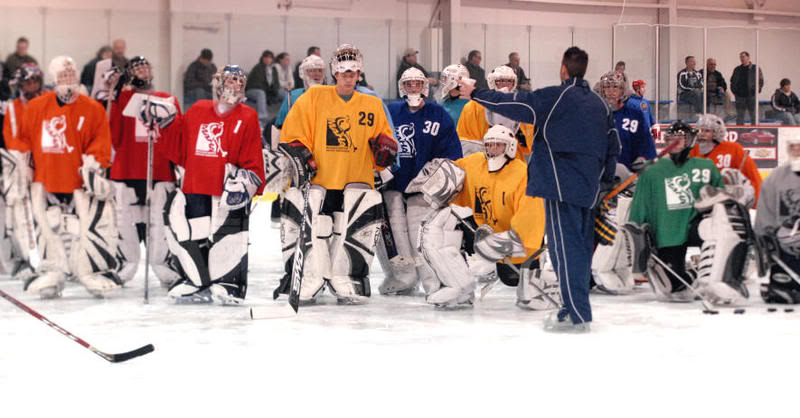
    This year, the York Simcoe Express chose a different venue for goalie selection and we think it worked very well. Instead of going into the regular team tryouts with an unmanageable number of goalies, the association allocated 4.5 hours of ice on two consecutive evenings for goalie assessment. On the Monday evening, for example, all the Novice, Minor Atom, and Atom goalies were put through various station drills that were set up to allow the goalies to demonstrate their skills. These were followed by the Minor Pewees, Pewees and Minor Bantams. The final session was for the Bantams, Minor Midgets and Midgets. While this was going on, the coaching staffs for the various age levels had a much better chance to focus on the goalies and offer some valid insights as to why a goalie was selected or not selected to advance to the scrimmage round of the tryouts. In fact, many coaches compiled detailed reports that they shared with the parents.

    Of course, this system isn’t perfect. Some goalies show better during games and often times the drills are so choreographed as to take the anticipation factor out of the assessment. Still, it gave the goalies a chance to demonstrate their skills in a controlled environment. How well these skills translated into game conditions was left to the next round. In the final analysis, the coaches were very pleased with the process and the parents and goalies knew that they were given a better chance to “strut their stuff”. That’s about all anyone could really hope for at this trying time of year.